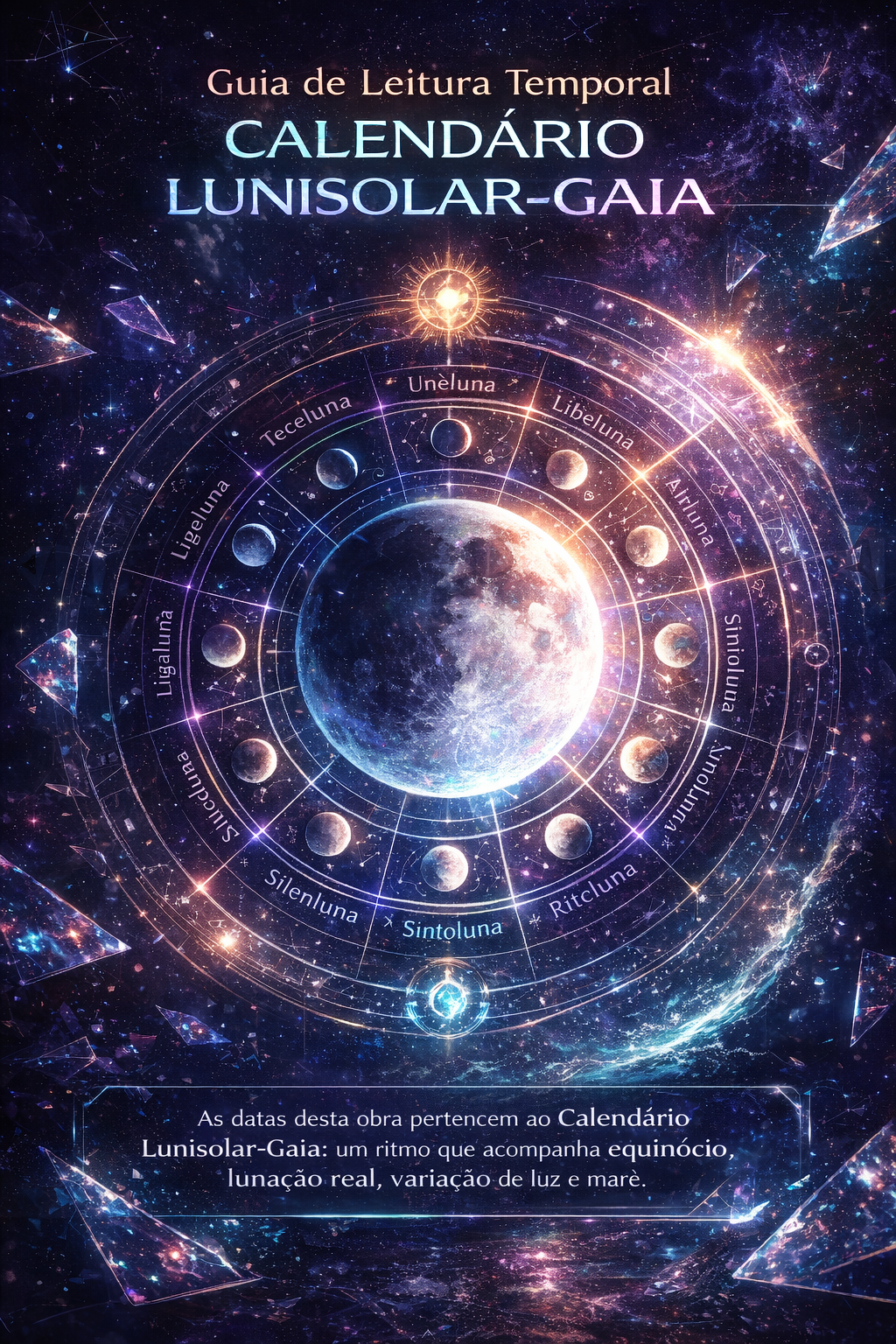
As datas desta obra pertencem ao Calendário Lunisolar-Gaia: um ritmo que acompanha equinócio, lunação real, variação de luz e maré.
Dentro de Universos Fragmentados, o tempo aparece como arquitetura observável: céu, estações e ciclos e ONRSALTUKWMH.
Nota — Por que Lunisolar-Gaia ao invés do Anticalendário Gregoriano
O anticalendário gregoriano desorganiza o tempo por decisões administrativas históricas.
Ele estabelece semana fixa de 7 dias por convenção religiosa e estatal, meses desconectados da lunação real, ajuste solar concentrado em fevereiro e contagem anual para padronização civil.
Ele destransforma o tempo em grade uniforme.
O anticalendário gregoriano impõe um antiritmo abstrato, separado da experiência observável do céu.
Ritmo vira contagem. Ritmo vira unidade administrativa. Ritmo vira medida externa.
O Calendário Lunisolar-Gaia organiza tempo/ritmo a partir do que aparece no céu e em ONRSALTUKWMH (silenciar, alongar, ritmar, sintonizar, aberturar, tecer, unir, liberar, fluxar, tramar, irradiar).
Ele estabelece ciclo solar iniciado no equinócio real, meses baseados em lunações reais, dias lunares por porcentagem de luz, e ciclos que sobem, atingem pico e descem.
1. ESTRUTURA GERAL
🌞 Ciclo Solar (S-)
O ano é chamado de Ciclo Solar, contado de Equinócio a Equinócio.
Conversão de referência:
S- = Ano Gregoriano + 745
Exemplo: 2134 → S-2879
🌙 12 Lunações
Cada ciclo solar possui 12 lunações (macro-ciclo):
- Silenluna
- Alonluna
- Ritluna
- Sintoluna
- Abeluna
- Ligaluna
- Teceluna
- Uneluna
- Libeluna
- Fluxluna
- Tramaluna
- Irraluna
Cada lunação carrega um arquétipo gestual dominante.
2. ANCORAGEM ASTRONÔMICA
Marco absoluto: 02 de fevereiro de 746 a.C. (juliano prolepítico) — eclipse lunar total observado na Babilônia.
Esse evento é historicamente registrado e astronomicamente reconstruível, servindo como âncora histórica + astronômica.
3. A LUNAÇÃO POR DENTRO
Cada lunação apresenta 30 dias lunares (0–29), organizados em 10 tríades por porcentagem de luz:
0–2  → 0–5%     → 0% → 5%      (OOO)
3–5  → 5–15%                (ONR)
6–8  → 15–30%               (SAL)
9–11 → 30–50%               (TUK)
12–14 → 50–85%              (WMH)

15–17 → 85–100% → 85%       (HMW)
18–20 → 85–60%              (KUT)
21–23 → 60–40%              (LAS)
24–26 → 40–15%              (RNO)
27–29 → 15–5% → 0%          (OOO)
Subida mais curta. Descida mais longa. Silêncio no início e no fim. Maré real respeitada.
🌙 Nomes dos dias (modelo aplicado)
OOO: 0 Silensi · 1 Silenabe · 2 Silenli
ONR: 3 Silensina · 4 Alonabe · 5 Ritli
SAL: 6 Sintosi · 7 Abeli · 8 Lilibe
TUK: 9 Tecesi · 10 Unabe · 11 Libeli
WMH: 12 Fluxsi · 13 Tramabe · 14 Irrali
HMW: 15 Irrasi · 16 Tramili · 17 Fluxli
KUT: 18 Libesi · 19 Unabe · 20 Teceli
LAS: 21 Ligasi · 22 Abete · 23 Sintoli
RNO: 24 Ritsi · 25 Alonli · 26 Silenli
OOO: 27 Silenri · 28 Silente · 29 Silenflu
4. DIAS SOLARES DE EIXO
O ciclo solar real é ~365,2422 dias. A diferença anual é ~5,2422 dias.
Por isso existem dias solares de eixo junto ao portal do Equinócio.
Ciclo Solar Comum:
Silena (ON) · Ritsi (RS) · Abeliga (AL) · Tecune (TU) · Libeflu (KW)
Ciclo Solar Sextal (aprox. a cada 4 ciclos):
- Tramirra (MH)
Esses dias realinham o ciclo solar e atuam fora das lunações.
5. NOTA TÉCNICA — CONVERSÃO DE LUNAÇÃO E DIA LUNAR (Lx)
A conversão de S- segue a conta fixa.
A localização exata da lunação e do dia lunar (0–29) pede efemérides astronômicas reais da Lua:
- datas e horas de Lua Nova, Cheia e Quartos
- duração real das lunações (média: 29,5306 dias)
- data real do Equinócio de março em cada ano
Efemérides (ex.: timeanddate.com, Stellarium) foram utilizadas para estruturar as datas desta obra.
Exemplo
14/02/2026 (sábado) → S-2770 → Tramaluna → dia 27: Silenri
Forma curta: 27/10/2770 — Silenri de Tramaluna — S-2770
Formato padrão: S-2770 • L10 Tramaluna • D27 Silenri
6. COMO LER UMA DATA NA NARRATIVA
Formato:
[Ciclo solar] • [LX] [Nome da Lunação] • [DX] [Dia Lunar]
Quando aparecer meia-lunação, ela entra como selo de fase.
Quarteluna = 6 dias
*Duas datas gregorianas específicas aparecem no livro como âncoras temporais, ajudando a pessoa leitora a se situar. Todas as demais seguem a contagem de tempo lunissolar.
TEMPORAL READING GUIDE — LUNISOLAR-GAIA CALENDAR
The dates in this work belong to the Lunisolar-Gaia Calendar: a rhythm that follows the equinox, real lunar cycles, variations of light and tide.
Within Fragmented Universes, time appears as an observable architecture: sky, seasons, cycles, and ONRSALTUKWMH.
Note — Why Lunisolar-Gaia instead of the Gregorian Anti-Calendar
The Gregorian anti-calendar disorganizes time through historical administrative decisions.
It establishes a fixed 7-day week by religious and state convention, months disconnected from real lunar cycles, solar adjustment concentrated in February, and an annual count designed for civil standardization.
It transforms time into a uniform grid.
The Gregorian anti-calendar imposes an abstract anti-rhythm, separated from the observable experience of the sky.
Rhythm becomes counting.
Rhythm becomes administrative units.
Rhythm becomes an external measure.
The Lunisolar-Gaia Calendar organizes time and rhythm according to what appears in the sky and in ONRSALTUKWMH:
silencing, elongating, rhythmizing, tuning, opening, weaving, uniting, releasing, flowing, structuring, irradiating.
It establishes:
- a solar cycle beginning at the real equinox
- months based on real lunar cycles
- lunar days defined by percentage of light
- cycles that rise, reach a peak, and descend
1. GENERAL STRUCTURE
🌞 Solar Cycle (S-)
The year is called a Solar Cycle, counted from Equinox to Equinox.
Reference conversion:
S- = Gregorian Year + 745
Example:
2134 → S-2879
🌙 12 Lunations
Each solar cycle contains 12 lunations (macro-cycles):
- Silenluna
- Alonluna
- Ritluna
- Sintoluna
- Abeluna
- Ligaluna
- Teceluna
- Uneluna
- Libeluna
- Fluxluna
- Tramaluna
- Irraluna
Each lunation carries a dominant gestural archetype.
2. ASTRONOMICAL ANCHOR
Absolute reference point:
February 2, 746 BCE (proleptic Julian calendar)
Total lunar eclipse observed in Babylon.
This event is historically recorded and astronomically reconstructible, serving as both historical and astronomical anchor.
3. THE LUNATION FROM WITHIN
Each lunation contains 30 lunar days (0–29) organized into 10 triads, defined by the percentage of lunar light.
0–2 → 0–5% → 0% → 5% (OOO) 3–5 → 5–15% (ONR) 6–8 → 15–30% (SAL) 9–11 → 30–50% (TUK) 12–14 → 50–85% (WMH) 15–17 → 85–100% → 85% (HMW) 18–20 → 85–60% (KUT) 21–23 → 60–40% (LAS) 24–26 → 40–15% (RNO) 27–29 → 15–5% → 0% (OOO)
Shorter ascent.
Longer descent.
Silence at the beginning and the end.
The real tide rhythm is respected.
🌙 Names of the lunar days (applied model)
OOO
0 Silensi
1 Silenabe
2 Silenli
ONR
3 Silensina
4 Alonabe
5 Ritli
SAL
6 Sintosi
7 Abeli
8 Lilibe
TUK
9 Tecesi
10 Unabe
11 Libeli
WMH
12 Fluxsi
13 Tramabe
14 Irrali
HMW
15 Irrasi
16 Tramili
17 Fluxli
KUT
18 Libesi
19 Unabe
20 Teceli
LAS
21 Ligasi
22 Abete
23 Sintoli
RNO
24 Ritsi
25 Alonli
26 Silenli
OOO
27 Silenri
28 Silente
29 Silenflu
4. SOLAR AXIS DAYS
The real solar cycle lasts ~365.2422 days.
The annual difference is ~5.2422 days.
For this reason there are solar axis days located near the Equinox portal.
Common Solar Cycle
Silena (ON)
Ritsi (RS)
Abeliga (AL)
Tecune (TU)
Libeflu (KW)
Sextal Solar Cycle (approximately every 4 cycles)
Tramirra (MH)
These days realign the solar cycle and exist outside the lunations.
5. TECHNICAL NOTE — CONVERSION OF LUNATION AND LUNAR DAY (Lx)
The conversion of S- follows the fixed calculation.
The exact position of the lunation and lunar day (0–29) requires real lunar astronomical ephemerides:
- dates and times of New Moon, Full Moon, and Quarter phases
- real duration of lunar cycles (average: 29.5306 days)
- the actual March Equinox of each year
Astronomical ephemerides
(e.g., timeanddate.com, Stellarium) were used to structure the dates in this work.
Example
14/02/2026 (Saturday)
→ S-2770
→ Tramaluna
→ Day 27: Silenri
Short form:
27/10/2770 — Silenri of Tramaluna — S-2770
Standard format:
S-2770 • L10 Tramaluna • D27 Silenri
6. HOW TO READ A DATE IN THE NARRATIVE
Format:
[Solar Cycle] • [LX] [Lunation Name] • [DX] [Lunar Day]
When a half-lunation appears, it functions as a phase seal.
Quarteluna = 6 days
A Gregorian date may appear in the book as a temporal anchor, helping the reader orient themselves.
All other dates follow the lunisolar time count.
 Fragmented Universes / Universos Fragmentados
Deixe um comentário